The One-on-One Isn't a Status Update
If your one-on-ones have become status dumps, something's broken. Here's what they should actually be — and how to reset them.

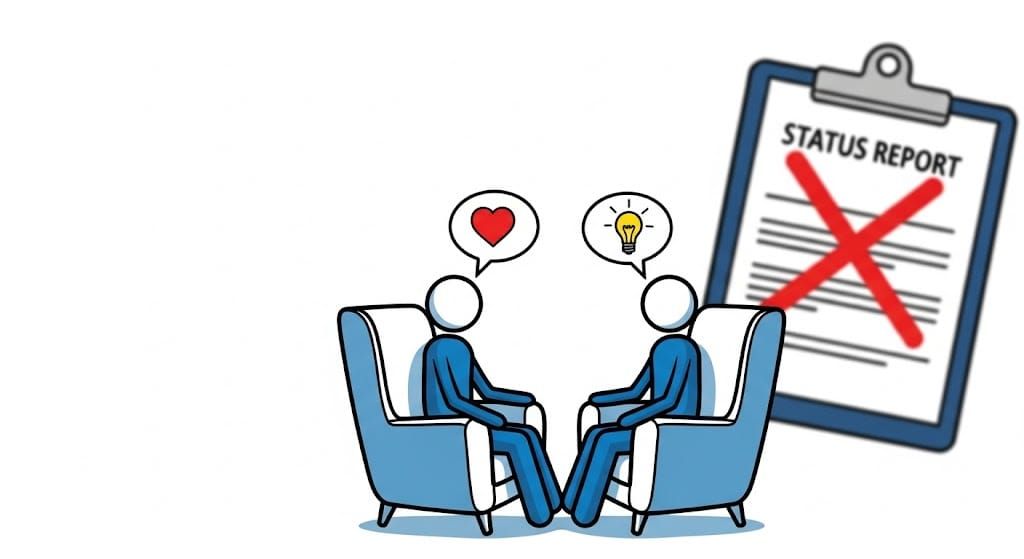
Most one-on-ones are status updates dressed up as development conversations. The manager asks what's on your plate. You run through the list. They ask a few questions. You answer. Everyone leaves feeling like something happened.
Nothing happened.
If you're spending your one-on-ones on status updates, you're in a bit of a failure mode. Not because status doesn't matter — it does — but because there are better places for it. Scrum ceremonies, scrum-of-scrums, project stand-ups, team syncs. Those are the forums for "here's what's in flight and where things stand." Your one-on-one with a direct report is not that forum.
When it becomes that forum, something breaks.
What status updates actually feel like
I've sat on both sides of this. I've been the one giving the status dumps, and I've been the one receiving them. Neither feels good.
When you're the one presenting status, you're essentially uploading your brain and hoping the other person can make sense of it. Here are all the facts I know. Here's where everything stands. Now you know what I know. The instinct behind this is understandable — especially for more junior folks. If I share everything with my boss, they'll be fully informed, and that's my job.
But it's not actually your job. Your boss doesn't need to know what you know. They need to know what insight you've drawn on top of what you know.
When you're on the receiving end of status updates, you end up in investigatory mode. You're asking question after question trying to find what's real and what matters. It starts to feel like stump-the-chump. The person giving status feels interrogated. The person receiving it feels like they're digging for truth. Nobody's sitting on the same side of the table. It's adversarial when it should be collaborative.
That dynamic is a symptom, not the disease. When one-on-ones become status dumps, it usually means something else is going on — leadership is in reactive mode, confidence is low, everyone's focused on immediate delivery instead of future direction. Status-update mode is a signal.
What the conversation should actually be
I'll be direct: I look forward to my one-on-ones. Not all of them, but most of them. When they're working, they're the place where I find green shoots of innovation before they become obvious. I hear about risks that are making people's stomachs rumble before they're making their bellies hurt. I find out what's getting the engineering team genuinely excited that we should probably be spending more time on.
That's useful. That's the kind of input that shapes my thinking on strategy and priorities in ways that no status deck ever could.
The shift from status to insight changes how the whole conversation feels. It becomes a conversation instead of an interrogation. Collaborative instead of combative. And it shifts the focus from what happened last week to what we're building toward.
Your job is to influence me
I tell my direct reports this explicitly: your job in this meeting is to influence me.
Not to recite facts. Not to prove you've been busy. Not to give me a project status I could read in a deck. Your job is to show me what you're seeing that I'm not, advocate for your perspective, and help me understand what we should be paying more attention to.
This is a mindset shift, especially for more junior folks. When you're early in your career, you're focused on execution — delivering the work, making sure what's been decided gets done with quality. Your instinct is to show up to one-on-ones ready to prove that. But at some point you need to start thinking like a leader. And leaders show up to meetings with a point of view, not just a report.
When I ask people not to give me status updates, I frame it three ways. First, it's a development opportunity — this is where you practice thinking and communicating like a senior leader. Second, it saves us both time — that status is available in a deck somewhere, and we have other forums for it. Third, it's about trust. When I say I don't need the play-by-play, I'm saying I trust you to own this. Don't tell me what you know. Tell me what you think.
What happens when people actually show up to influence
Here's a concrete example of why this matters.
I was working through an org change. A product leader on my team was growing and needed more scope and responsibility. I had a rough set of options in my head — different ways to move teams around to give people opportunities and better align things. Nothing was decided. I was still thinking.
So instead of coming into my one-on-ones with a decision, I came in with my thinking. I shared pieces of it with different people, asked what they'd do in those scenarios, listened to what came back.
What I found out: people were thinking about things I hadn't surfaced. One person wanted an opportunity I hadn't realized they wanted. Another had concerns about a specific structure I'd been favoring. That input shaped the actual org change in ways that made it land better for everyone.
If those one-on-ones had been status updates, none of that would have surfaced. The person giving status doesn't think to raise "by the way, here's what I want from the org change you're designing." They're not thinking in those terms. They're thinking about the work in front of them.
But when you invite people to influence you, they show up differently. They think bigger. They bring perspective you actually need.
The practical shift
If your one-on-ones have defaulted into status mode, here's how to reset them.
Tell people directly. Explain that status updates are available in other forums and you trust them to surface something in this meeting only if this is the absolutely necessary place for it. Then tell them what you actually want: come prepared to talk about what's exciting you, what's concerning you, and what you think you should both be focusing on more. Come ready to influence and advocate for your perspective.
Give it a few cycles. The first time or two, people will still default to status because it's what they know. Push back gently. Ask: "What do you think we should be paying more attention to?" or "What's something you're seeing that I'm probably not?" Pull the insight out of them until they start bringing it in on their own.
One-on-ones are the highest-value conversation you can have with a direct report. Don't waste them on information you could read in a deck.
The other skill that makes one-on-ones work: giving feedback people can actually hear. See How to Give Feedback That Sticks for the delivery framework — and How to Give Feedback That Actually Lands for the full end-to-end approach.