Delegation Isn't About Assigning Tasks
Most managers think delegation means handing off a task list. It doesn't. Real delegation transfers outcome ownership — and that requires a fundamentally different approach to how you assign work.


You get promoted. Suddenly you can't do all the work yourself anymore. So you do what feels natural: you show people how to do it by doing it in front of them.
It doesn't work.
People watch you work, get confused about why you're making the choices you're making, and then they try to copy the motions without understanding the logic. They deliver something that technically follows your process but misses the whole point. You end up frustrated because they "didn't get it."
The problem isn't delegation. The problem is you're treating it like task assignment instead of outcome ownership.
Delegation Is About Transferring Thinking, Not Tasks
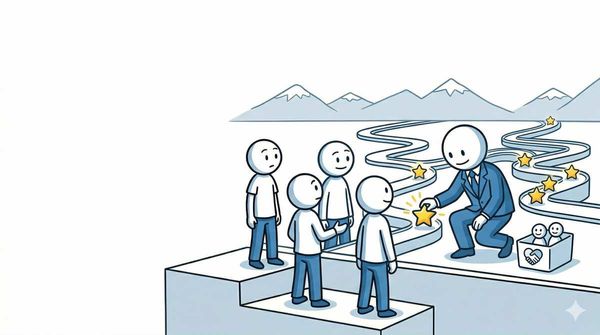
When you delegate well, you're saying: "Here's the outcome I need. Here's why it matters. Here's what done looks like. Now go figure out how to get there."
When you delegate poorly, you're saying: "Do this. Then do that. Then this." And when they ask why, you realize you haven't explained the strategy — you've just listed tasks.
I learned this early. I was managing project managers on a massive banking integration. I'd been successful running individual work streams, so I tried to show them what I'd been doing and hoped they'd model it.
What actually happened: confusion. I was giving direction without explaining why that direction mattered. People felt like they were executing my vision, not building their own. There was no buy-in. Just compliance.
The shift came when I stopped showing and started leading with outcome. I'd say, "Here's the customer problem. Here's the business outcome. Here's the timeline. How would you approach this?" Suddenly they had skin in the game. They understood what success meant, not just what the first step looked like.
The Biggest Mistake Managers Make
Managers are prescriptive with tasks without investing in the strategy. They hand off a to-do list and hope the person understands why those to-dos matter.
If you're not bought into the strategy, a task list just feels like busy work. It's arbitrary. It feels like someone doesn't trust your judgment.
But if you understand the why, that same list becomes a roadmap. You know why each thing matters. You can make judgment calls when things change. You can adapt because you know what you're actually trying to accomplish.
Think about the peanut butter sandwich instruction problem. If someone gives you detailed steps — "Cut with knife. Spread on bread. Add jelly" — and you follow them exactly, you might cut something other than the sandwich because you don't understand the context. You just have steps.
That's what happens when managers delegate prescriptively without strategy. People follow the steps. Things go sideways. The manager blames the person instead of realizing they set them up to fail.
When Someone's Actually Ready
I don't sit around assessing whether someone's ready to be delegated to. That keeps me stuck.
I look at the work that needs to happen, I look at the person in the role, and I ask: "Is this their job?" If yes, I delegate it. Then I watch whether they rise to the occasion.
The best signal someone's ready is when they come to you saying, "I'm the bottleneck on this. I'm blocking the team. Can I take on more?" When someone sees the gap and wants to fill it, that's a clear sign they're ready for more responsibility.
Readiness Isn't Binary
Here's what managers get wrong: readiness isn't a threshold you cross. It's a spectrum.
Someone can be "kind of ready" for something they've never done before. That's usually when the real development happens. If they were fully ready, they wouldn't be learning anything.
The question isn't "Are they ready?" It's "Are they ready enough, and am I willing to support them while they grow into it?"
I've had people I wasn't 100 percent sure about. But I could see they had the foundational capabilities, the judgment, and the willingness to figure things out. So I delegated. Sometimes it went sideways. Sometimes they surprised me. Either way, they learned something I couldn't have taught them in a training.
The worst thing a manager can do is play it so safe that they never stretch anyone. You end up with a team that can only do what they already know how to do. You don't scale. Your people don't develop.
The Mindset Shift You Have to Make
When you move from doing the work to having someone else do it, something fundamental has to change.
You have to accept that they're going to do it differently than you would. And different isn't automatically wrong.
I used to get stuck on the how. I'd delegate something, they'd come back with an approach that wasn't mine, and I'd immediately start editing — change this word, restructure this section, do it this way instead. I was treating feedback like corrections instead of coaching.
What changed is I started asking: "Does this actually accomplish what we need?" instead of "Is this exactly how I'd do it?"
When you shift to outcome-focused feedback, you're not micromanaging execution. You're having a conversation about whether the work solves the problem. If it does, let them run with it. If it doesn't, you dig into why and figure out what needs to shift.
You can trust someone completely and still have them solve problems differently than you would. Those aren't the same thing.
Delegation Is How You Scale
Look at any effective leader in a large organization — they have a handful of people working for them, but they're driving work across the entire company. They're not the best at every job their direct reports do. They're directing the work.
Those leaders aren't stewards of execution. They're stewards of outcomes. They're responsible for what gets delivered, not how everyone does their job.
The more you develop your team to take on bigger work, the more you free yourself up to do higher-level work. The more you can delegate, the more your team can deliver.
And here's what matters for you: the more you develop people to handle strategic work, the better you get at talking about work at a strategic level. You learn how to break down complex problems, how to guide thinking without prescribing answers, how to lead without doing. Those are the skills that matter at higher levels.
Your team's development isn't separate from your development. It's the same thing.
What Actually Gets in the Way
Most managers don't delegate as much as they should. And it's not usually because they don't know how. It's because they're afraid.
Afraid the person will fail. Afraid they'll look bad. Afraid that if they're not the one doing the work, nobody will see their value.
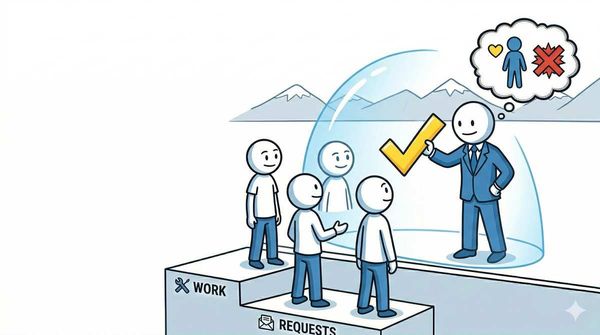
The real fear is losing control. Control feels like safety. When you're doing the work yourself, you know what's going to happen. When someone else is doing it, you have to be okay with outcomes you didn't engineer.
I've held on to work I should have delegated because I didn't trust the person enough, or I wasn't confident in their approach, or I just wanted to make sure it was done right. Every time I did that, I sabotaged my own growth.
Here's what I'd tell a manager who's worried about giving up control: Clean up your own backyard first. Look at everything on your plate. What could you just stop doing with no real consequences? What's work you're doing out of habit, not because it's critical? Get rid of that first.
Then separate what only you can do (because you have unique context or authority) from what you're just doing because you're used to doing it. Hand off the second pile.
The hard part is accepting that outcomes won't be exactly like you'd do them. And that's okay. You're not managing a portfolio of clones. You're managing a portfolio of outcomes. Some will be shaped differently than you'd shape them. That's the point.
The Identity Crisis
This is the real barrier for a lot of managers, and I'll be honest about it because I've lived it.
When you move from individual contributor to manager, there's an identity crisis. You were great at doing the work. You got status and security from being really good at your job. Now you're not doing the work anymore. So where's your value?
You have to shift to seeing your value as a multiplier. Your job is to make your team better, faster, more capable. Your output is their output. Your success is their success.
That sounds nice in theory. It feels terrible in practice when you're not the one in the meeting presenting the idea or solving the problem.
Here's the move: Look for moments where your direct report answers a question in a meeting and nails it. In that moment, shut up. Let them answer. Don't jump in and add to it or correct it or take credit. Just let them be the expert.
When you do that consistently, two things happen. First, they build confidence. Second, you build credibility as someone who develops people. You start to see that your value isn't in being the smartest person in the room. It's in building rooms full of smart people.
That's a different kind of power. And it scales a lot better.
When delegation goes wrong, it usually isn't the person's fault — it's the setup. Read Why Delegation Fails (And It's Usually Your Fault) to see the most common breakdown points. And if you're unsure whether someone is actually ready for more responsibility, Delegation and Trust: How to Know When Someone's Ready breaks down how to assess that honestly.