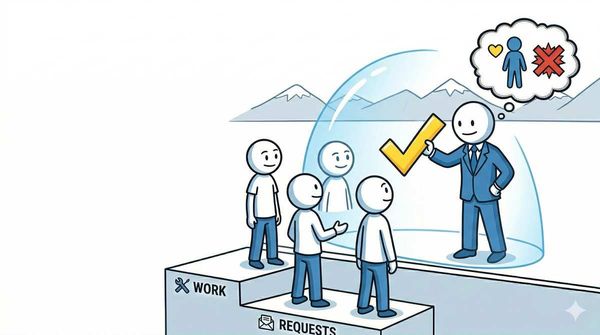
How to Give Feedback That Actually Lands
Most managers give feedback. The person nods. Nothing changes. Here’s why feedback doesn’t land — and how to fix it.

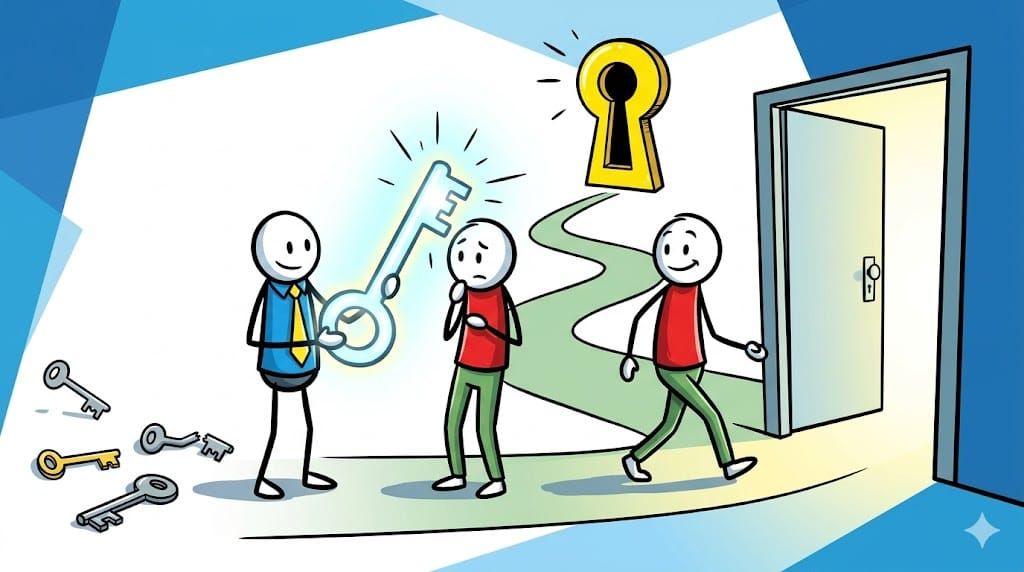
When feedback lands, it changes behavior. The person doesn’t get defensive. They hear you. And weeks later, you notice things are different — not because you forced it, but because something clicked.
Most managers have never actually experienced that. They give feedback, the person nods, and nothing shifts. So they assume feedback doesn’t work, or that some people just can’t hear it.
That’s not true. The feedback just wasn’t built to land.
The Eric Problem
Eric was an associate I hired years ago. Smart, motivated, wanted to grow. He was always asking leadership for guidance on what to do next — which sounds great on the surface. But Eric also had a very strong perspective on what that guidance should be.
So he was stuck in a loop. Asking for direction while being locked into one specific way of thinking about the solution. When he’d share updates, he’d get hyper-focused on one approach and miss the larger opportunities entirely. He’d come in looking for validation, not input.
I could’ve told him, “You need to be more open-minded.” That would’ve landed nowhere.
Instead, I thought about what actually motivated Eric. He wanted recognition. He wanted ownership. He wanted his ideas to matter. So I reframed the feedback around that.
“Stop trying to figure out how to slice the pie,” I told him, “and start figuring out how to make it bigger. If your vision is big enough, everyone can see themselves in it. You get more buy-in, more ownership, more recognition — not less.”
That was the unlock. Because I wasn’t asking him to abandon what he cared about. I was showing him a better path to get there.
In our follow-up one-on-ones, I could see it shifting. He started leading with the bigger picture. He opened the conversation before staking out his position. That created space for creative problem solving that hadn’t existed before.
The feedback landed because it was tied to who Eric actually was — not just what I needed him to do differently.
What Kills Feedback Before It Starts
The biggest mistake managers make is burying the message.
Feedback starts direct: You need to improve your written communications. Good. Clear. Then the qualifiers start piling on. Well, particularly when writing to executives. Or in situations where you’re presenting data. Or when the audience is cross-functional. It’s not always a problem, just in certain scenarios.
By the time you’re done, the person’s thinking: So maybe it’s not really a problem?
The feedback gets diluted because the manager is trying to be so precise about the context that they accidentally make it sound optional. Or they’re afraid of coming across as unfair. Or — and this one’s worth being honest about — they’re not confident enough in the feedback to actually stand behind it.
If you’re not sure the feedback is right, that’s a different conversation. But if you believe it, say it clearly. Qualifiers are for lawyers, not managers.
The hidden cost of vague feedback compounds over time in ways most managers don’t see until it’s too late. I go deeper on that in The Hidden Cost of Vague Feedback.
The Feedback You’re Not Qualified to Give
Here’s one I had to learn the hard way.
I used to take feedback I’d received from my own leadership and pass versions of it down to my team. Ryan needs to develop a stronger narrative flow. Okay. So I’d make that feedback for my associates too.
The problem: if I was getting feedback on something I wasn’t strong at myself, the guidance I was giving was pulling people in the wrong direction. And they didn’t know any better. They trusted me.
Feedback should come from a place where you actually know what better looks like. Not just because someone told you it was important. If you’re coaching someone on strategic narrative and you’ve never built one yourself, you’re guessing. And they’re following your guess.
Why Feedback Doesn’t Land When It Should
Most people who resist feedback aren’t trying to be difficult. They’re running a very human pattern: as soon as they hear feedback, they start scanning for reasons it doesn’t apply.
You said I don’t communicate clearly. But in that meeting, I didn’t have all the context. If you knew what I knew, you’d see it differently. So your feedback isn’t really valid.
They’ve defeated the feedback without engaging with it. And they’ve learned that this move works — that if they find the flaw in your observation, they don’t have to do anything with it.
That’s not a feedback problem. That’s a mindset problem. And you can’t fix it by giving better feedback. You have to address the pattern directly.
How to Handle Pushback in the Moment
When someone pushes back on feedback, the first move is to listen — and to make sure they know you heard them before you respond. I write about that in How to Echo Back What You’re Hearing. You might not have all the information. Staying open to that isn’t weakness — it’s good judgment.
But if the pushback is a pattern — if every piece of feedback gets interrogated until it collapses — that’s a different problem. At that point, the conversation isn’t about the feedback anymore. It’s about the person’s relationship with feedback itself.
My move in those situations: I’ll name it directly. I’m not here to litigate whether this feedback is accurate. I’m here to share it. If you want to talk about what to do differently, I’m happy to do that. But I’m not going to keep defending the observation.
If it continues, I exit the conversation gracefully. And I make a development note: this person needs help learning how to receive feedback. That’s real work, and it matters more than winning an argument about whether the feedback was fair.
For a more detailed breakdown of how to handle pushback in the moment — including what to do when it becomes a pattern — read When Someone Pushes Back on Your Feedback.
Timing Is Part of the Message
Feedback given at the wrong moment doesn’t land — even if it’s exactly right.
The worst time to give feedback is when you’re embarrassed. When something just went sideways in a meeting, or a deliverable missed badly, and you’re still in the emotional aftermath of it. In that state, you’re not giving feedback. You’re processing. And the person on the receiving end can feel it.
My practice: write it down in a few words. So-and-so needs help with X. Save it. Come back to it the next day. By then, the emotion has settled. You can look at it with clearer eyes and figure out if it still holds, and how to say it in a way that actually helps.
The other timing mistake is moving too fast. Sometimes you need to let a situation play out before you give feedback on someone’s judgment. If you jump in too early, you might be giving feedback on a decision that would’ve resolved itself. Or worse, you’re second-guessing someone who actually knew more about the situation than you did.
Ask yourself: is this tactical feedback that needs to happen now, or is this a judgment call I need to see fully play out first?
I write about the full timing question — when to give it immediately, when to wait, and what happens when you hold it too long — in Feedback Timing: Why 24 Hours Changes Everything.
When Feedback Becomes Culture
The best feedback cultures aren’t built around a policy or a training program. They’re built around a shared commitment to getting to the truth.
The team I’m on now operates around what we call truth-seeking. You state your hypothesis, you explain why you believe it, and you defend it against real questions. No nodding. No vague approval. You’re going to hear the feedback — all of it.
That can be uncomfortable for people who aren’t used to it. Some people leave. But the ones who stay get stronger fast, because the feedback is constant and real. You can’t hide in a truth-seeking culture. And that turns out to be exactly what most people need.
Building that culture starts with modeling it yourself. Ask hard questions. Be honest when something’s not working. Invite people to push back on your thinking. And when someone gives you feedback — even feedback you don’t like — receive it like it’s worth something.
Because it is.
If you want to go deeper on how to build this from the ground up — including how to onboard someone into a truth-seeking culture — read Building a Feedback Culture (Not Just Moments).
This is part of a series on feedback for working managers. If you’re also thinking about how feedback connects to your review cycle, start with Why Performance Reviews Fail. And if your one-on-ones have become status updates, that’s worth fixing first.